Published on September 25, 2026
An Enzyme That Works Near the Boiling Point: Nitrogen Fixation Caught at Near-Atomic Resolution
🇮🇹 Leggi in Italiano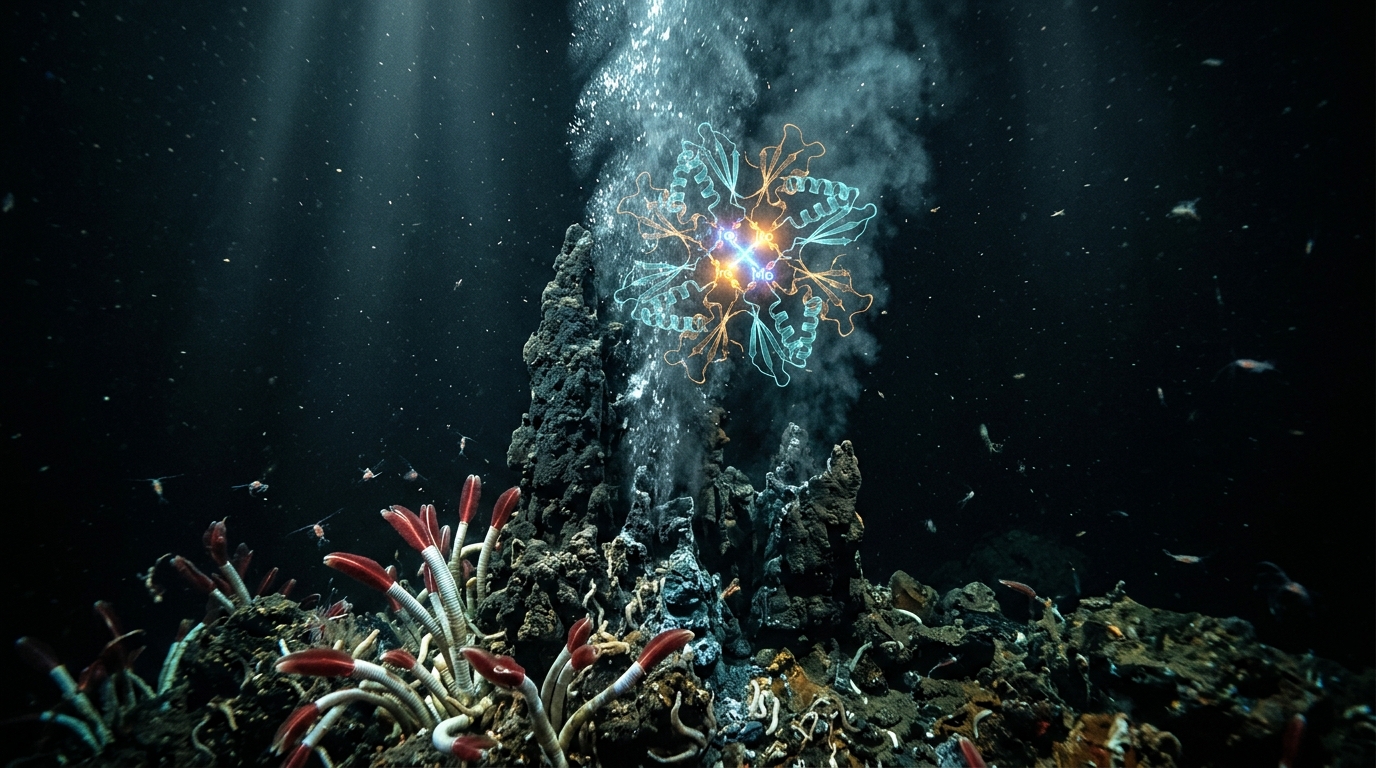
For more than a century, the industrial synthesis of ammonia has depended on the Haber–Bosch process, which forces nitrogen and hydrogen together at several hundred atmospheres and temperatures approaching 500 °C, consuming on the order of one to two percent of the world’s energy in order to break a triple bond that nature dismantles at ambient temperature and pressure. The enzyme responsible, nitrogenase, has therefore been studied for decades as both a chemical puzzle and an industrial provocation. What has resisted explanation is not that the reaction happens but how it unfolds, step by step, because the iron–molybdenum cofactor at the catalytic center passes through intermediates that are fleeting, oxygen-sensitive, and notoriously difficult to trap in a crystal.
A study published on 8 September 2026 in Nature Communications, from Tristan Wagner’s group at the Max Planck Institute for Marine Microbiology in Bremen with structural work carried out in Grenoble, approaches the problem from an unusual direction: rather than engineering a familiar bacterial enzyme, the authors went to Methanocaldococcus infernus, a deep-sea hyperthermophilic archaeon that fixes nitrogen while growing at 92 °C. The enzyme was purified from its native host rather than produced recombinantly, and it proved to melt at roughly 92 °C, some thirty degrees above the canonical Azotobacter vinelandii protein. The resulting crystal structures, at 1.21 and 1.37 Å, describe the most structurally simplified nitrogenase reported to date, stripped of accessory features present in bacterial homologues yet carrying identifiable hot spots that account for its thermal resilience.
What the structures reveal about the mechanism is worth more than the heat resistance itself. Nitrogenases come in three known varieties, built around molybdenum, vanadium, or iron alone, and this archaeal enzyme carries features of all three at once — which supports the idea that the earliest nitrogenases looked more like this one than like the bacterial versions studied for decades. Two details stand out. The P-cluster, the metal hub that ferries electrons toward the active site, was caught waiting for its next electron, a moment rarely seen. And the FeMo-cofactor, where nitrogen is actually pulled apart, appeared in two forms at once: at rest, and mid-reaction. That working state had previously been seen only in the vanadium and iron-only enzymes, so finding it here suggests all three varieties follow the same underlying chemistry — a shared logic hidden until now by the habit of studying one version at a time.
The authors are refreshingly open about what the work does not settle. The very mixture of states that makes catalysis visible also blurs it: inside the cofactor, one small bridging piece could not be identified with certainty, and pinning it down will require a different technique. A crystal structure is a photograph, not a film: it shows where the atoms sit, not how they move. And the claim that this enzyme outperforms its ordinary-temperature relatives comes from a calculation projected to 80 °C, not from a measurement taken at the vent itself. One organism is a starting point, not a rule.
Why it matters is easier to state. Enzymes that survive heat are valuable raw material, because industrial processes are hot, and a protein that falls apart at 60 °C is of little use outside a test tube. A naturally heat-proof enzyme gives protein engineers a sturdy scaffold to build on, whether the goal is a gentler route to fertilizer or tougher biocatalysts for pharmaceutical manufacturing. The deepest question is still open, and it is the one worth following: how a handful of iron and molybdenum atoms persuades one of chemistry’s most stubborn bonds to let go.